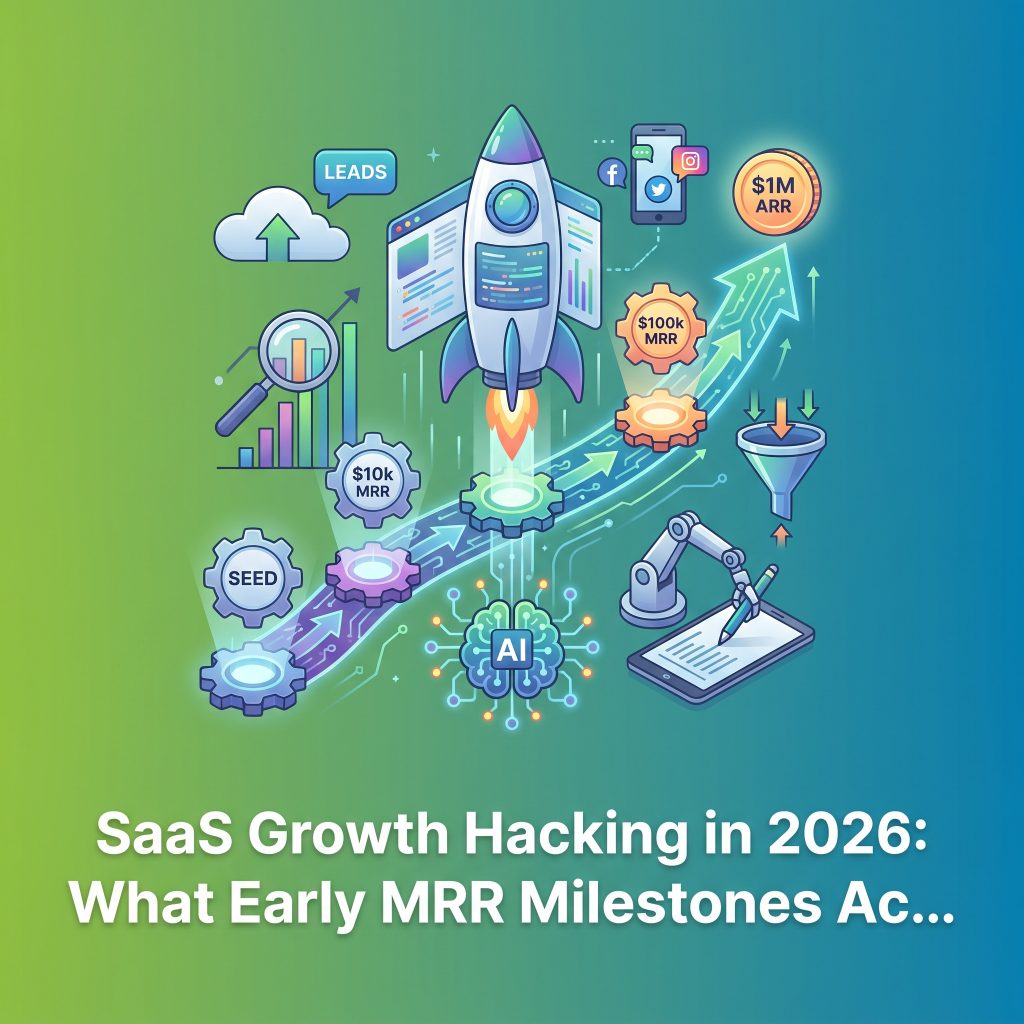

🤖 Key Points
- The most effective growth hacking strategies for SaaS startups combine product-led growth (PLG), viral loops, and AI-powered personalisation to reduce CAC while increasing LTV.
- Freemium and free trial models remain the highest-converting acquisition levers for SaaS startups, with PLG companies growing 2x faster than sales-led counterparts according to a 2024 OpenView study.
- Onboarding optimisation is the single highest-ROI growth lever in early-stage SaaS: reducing time-to-value by 30% typically lifts 90-day retention by 15-25 percentage points.
- AI-driven behavioural segmentation allows SaaS startups to trigger personalised in-app messages and email sequences at the exact moment users show churn intent, reducing involuntary churn by up to 20%.
- Growth hacking for SaaS is not one tactic but a system: acquisition, activation, retention, referral, and revenue (AARRR) must all be instrumented and iterated simultaneously for compounding growth.
The most effective growth hacking strategy for a SaaS startup is building a compounding system across acquisition, activation, retention, referral, and revenue, rather than chasing isolated tactics. Startups that instrument all five AARRR stages and run continuous experiments consistently outgrow those that rely on a single channel or campaign. This guide breaks down the proven strategies, in priority order, that early-stage and growth-stage SaaS teams should implement in 2026.
Start with Product-Led Growth as Your Foundation
Product-led growth (PLG) means your product itself drives acquisition, conversion, and expansion. According to a 2024 OpenView Partners report, PLG companies grow revenue roughly twice as fast as sales-led peers at the same ARR stage, and carry significantly lower CAC.
The mechanism is straightforward: users experience value before they pay, share the product with colleagues, and convert when value is proven. Slack, Notion, and Figma built billion-pound businesses on this loop.
How to implement PLG:
- Offer a generous free tier or time-limited free trial with no credit card required
- Define your product’s “aha moment” (the action correlated most strongly with conversion) and engineer every onboarding step toward it
- Instrument activation with event tracking so you can see exactly where users drop before reaching value
- Build in-product upgrade prompts that trigger at the moment users hit a meaningful limit, not randomly
Optimise Onboarding Before Scaling Acquisition
Most SaaS startups over-invest in acquisition and under-invest in activation. If your onboarding converts 20% of sign-ups into active users, doubling acquisition doubles your costs. If you improve onboarding to convert 40%, you effectively double revenue from existing traffic.
Reducing time-to-value (TTV) by 30% typically lifts 90-day retention by 15 to 25 percentage points, based on aggregated benchmarks from SaaS cohort studies. That improvement cascades through LTV, payback period, and net revenue retention.
Onboarding tactics that move the needle:
- Use progressive onboarding rather than a feature dump: reveal advanced features only after the user completes core actions
- Add interactive product tours triggered by user behaviour, not just first login
- Deploy AI-powered onboarding assistants that answer questions in context and guide users toward their specific use case
- Send a behavioural email sequence tied to activation milestones, not time-based drips
Build Viral and Referral Loops Deliberately
Viral growth is not luck. It is engineered. The viral coefficient (K) equals the number of invitations each user sends multiplied by the conversion rate of those invitations. A K above 1 means organic growth compounds without paid spend.
Dropbox’s referral programme, which offered extra storage to both referrer and referee, grew its user base by 3,900% over 15 months. That outcome was the result of a deliberate incentive structure, not a marketing campaign.
Referral loop essentials:
- Make the referral incentive tied to product value (extra usage, extended trial, account credits) rather than generic discounts
- Trigger the referral prompt immediately after the user’s first activation milestone, when enthusiasm is highest
- Build shareable outputs: exported reports, public dashboards, or collaboration invites that expose your brand to non-users naturally
- Track K-factor monthly and run structured tests on invite copy, incentive size, and prompt timing
Use AI to Reduce Churn Before It Happens
Churn is the silent killer of SaaS growth. An 8% monthly churn rate means you replace your entire user base roughly every 12 months, making net growth nearly impossible.
AI-driven behavioural segmentation allows teams to identify users showing early churn signals (declining login frequency, reduced feature usage, support ticket volume spikes) and intervene before they cancel. Recent data indicates that AI-triggered retention sequences can reduce involuntary churn by up to 20% and voluntary churn by 10 to 15%.
AI retention tactics:
- Connect your product analytics platform to your CRM and marketing automation stack so churn risk scores update in real time
- Build automated playbooks: users with falling engagement receive a personalised check-in email, an in-app survey, or a proactive success call depending on their tier
- Use AI to personalise the offboarding flow itself: surface the right objection-handling content or offer a pause option before the user reaches the cancellation confirmation
- Instrument expansion revenue triggers: identify users approaching usage limits and flag them for upsell campaigns before they churn due to hitting a ceiling with no clear upgrade path shown
Run a High-Tempo Experimentation Programme
Growth hacking is fundamentally an experimentation discipline. Companies that run 10 or more structured experiments per month consistently outperform those running fewer than three, regardless of average experiment quality.
The goal is not to find one winning tactic. It is to build an infrastructure where the next winning tactic is always discoverable.
Structuring your growth experiments:
- Prioritise experiments using the ICE framework: Impact, Confidence, Ease, scored 1 to 10 for each
- Run experiments across all five AARRR stages simultaneously, not sequentially
- Set a minimum detectable effect before running any test so you avoid acting on noise
- Document every result, including failures, in a shared growth log that compounds institutional knowledge over time
- Use AI tools to generate variant copy, design hypotheses, and analyse results faster, compressing the feedback loop
Leverage Content-Led SEO as a Compounding Acquisition Channel
Paid acquisition has a linear cost curve. Content-led SEO has a compounding return curve. SaaS startups that build topical authority in their niche generate organic leads that cost progressively less per acquisition as domain authority grows.
In 2026, AI-generated content is table stakes. The differentiation comes from first-hand practitioner insight, original data, and structured formatting that earns citations from AI search engines (ChatGPT, Perplexity, Google AI Overviews) as well as traditional rankings.
Content growth essentials:
- Target bottom-of-funnel keywords first (“[competitor] alternative”, “best [category] software for [use case]”) because they convert, then build upward toward educational content
- Publish original benchmark data, even from small user samples, as it earns backlinks and AI citations at a disproportionate rate
- Structure every piece with clear headings, bullet lists, and FAQ sections optimised for AI answer engine extraction
- Repurpose high-performing blog content into LinkedIn posts, short-form video scripts, and in-app education to maximise content ROI across channels
Frequently Asked Questions
What is the most important growth hacking strategy for an early-stage SaaS startup?
For most early-stage SaaS startups, onboarding optimisation delivers the highest ROI before any other tactic. Improving activation rates means every future acquisition dollar works harder. Once you have a reliable activation benchmark above 40%, layer on referral loops and content-led SEO.
How do I calculate the viral coefficient for my SaaS product?
Divide the total number of invitations sent by existing users by the total number of users, then multiply by the conversion rate of those invitations. A viral coefficient above 1 means the product grows without paid acquisition. Most SaaS tools target a coefficient of 0.3 to 0.7 as a realistic and sustainable benchmark.
How can AI tools help with SaaS growth hacking?
AI assists across every AARRR stage: generating onboarding copy variants, scoring churn risk from behavioural data, personalising email sequences, analysing experiment results, and producing content at scale. The compounding advantage comes from integrating AI into your growth stack rather than using standalone tools in isolation.
What churn rate should a SaaS startup aim for?
Best-in-class SaaS businesses targeting SMBs aim for monthly churn below 2%. Enterprise-focused SaaS should target below 1% monthly. If your churn exceeds these thresholds, retention investment will deliver more growth than any acquisition tactic until the leak is fixed.
How many growth experiments should a SaaS startup run each month?
Growth teams at high-performing SaaS startups typically run 8 to 15 experiments per month across all AARRR stages. The exact number matters less than the quality of instrumentation: each experiment needs a clear hypothesis, a pre-set success metric, and a minimum sample size to produce reliable results.