
2027 annual edition · 1995–2050
From the Internet to the Singularity
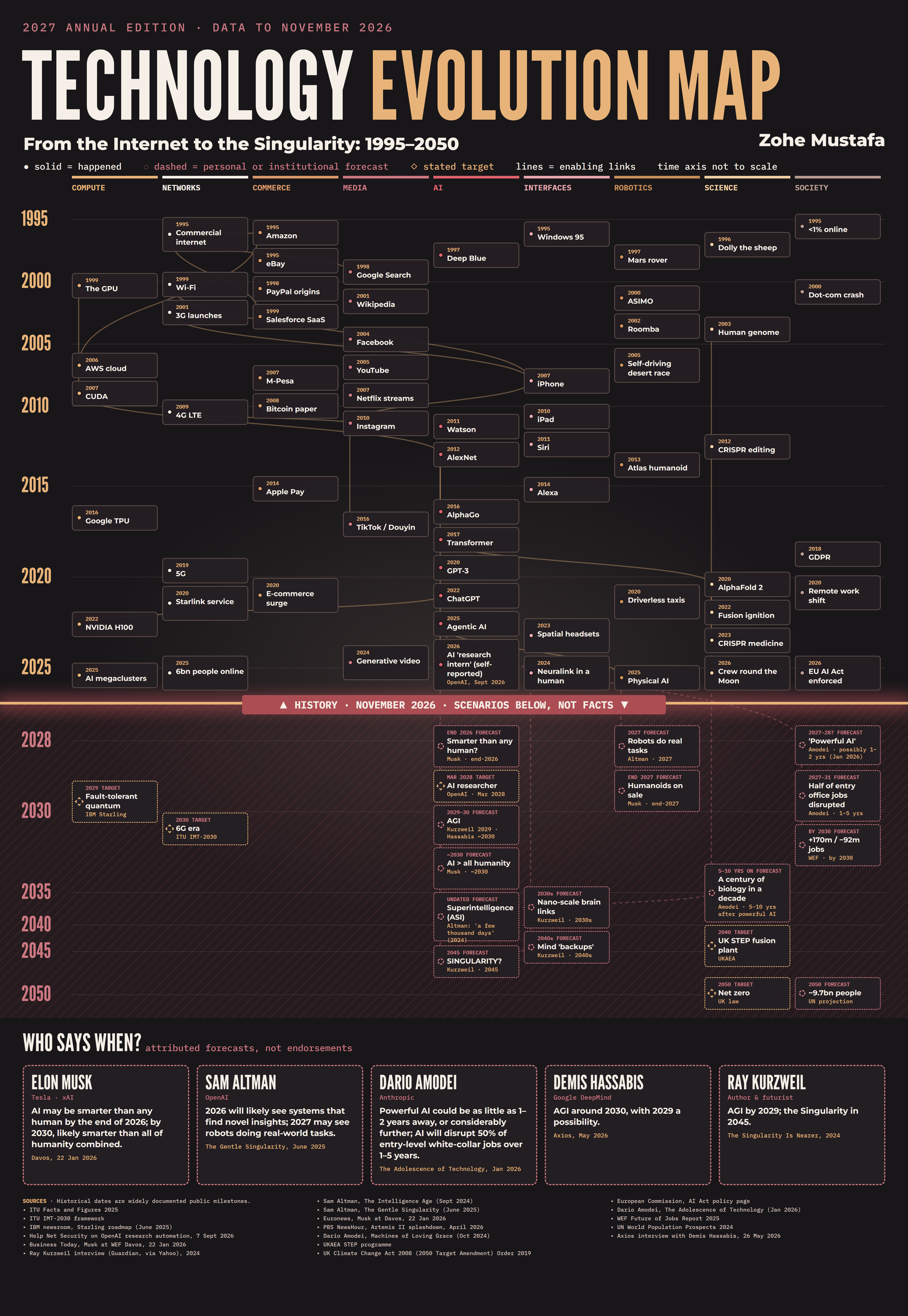
The Technology Evolution Map traces nine technology streams from the commercial internet to agentic AI, then explores how computing, commerce, robotics and the rest might evolve through 2050.
Watch the flagship film
95 seconds tracing the milestones and connections that shape the map.
Explore the full map
Select the map to open the full-resolution image and zoom into the detail.
Why I built the map
I’m Zohe Mustafa, founder of Growth Hakka. Over three decades in digital and growth, I’ve watched the web, mobile, cloud and AI change how people find, buy and build things. What interested me most was how one shift made the next possible.
I built the map to make those connections visible. It starts in 1995, when the commercial web was taking shape, and carries the timeline forward to 2050. The future half is an invitation to ask what would have to happen for each milestone to become real.
Browse the timeline by stream
Open a stream for selected milestones. The full map shows the links between them.
Computing & infrastructure
- 1999 · The GPU
- 2006 · AWS cloud
- 2016 · Google TPU
- 2029 · IBM Starling fault-tolerant quantum computing target
Connectivity & networks
- 1995 · Commercial internet
- 1999 · Wi-Fi
- 2019 · 5G
- 2030 horizon · ITU IMT-2030 framework
Commerce & business
- 1995 · Amazon and eBay
- 2007 · M-Pesa
- 2008 · Bitcoin paper
- 2020 · E-commerce surge
Media & social
- 1998 · Google Search
- 2005 · YouTube
- 2007 · Netflix streaming
- 2024 · Generative video
Artificial intelligence
- 1997 · Deep Blue
- 2012 · AlexNet
- 2017 · Transformer
- 2022 · ChatGPT
- 2025 · Agentic AI
- 2029–30 · AGI forecasts
Interfaces & augmentation
- 1995 · Windows 95
- 2007 · iPhone
- 2011 · Siri
- 2023 · Spatial headsets
- 2024 · First Neuralink human implant
- 2030s · Nanoscale brain links (forecast)
Robotics & physical AI
- 1997 · Mars rover
- 2000 · ASIMO
- 2002 · Roomba
- 2013 · Atlas humanoid
- 2020 · Driverless taxis
- 2027 · Robots doing real-world tasks (forecast)
Science, energy & biotech
- 2003 · Human Genome Project completed
- 2012 · CRISPR editing
- 2020 · AlphaFold 2
- 2022 · Fusion ignition
- 2040 horizon · UK STEP fusion plant (target)
Society & employment
- 2000 · Dot-com crash
- 2018 · GDPR
- 2020 · Remote work shift
- 2026 · EU AI Act implementation
- 2050 · Around 9.7 billion people (UN projection)
Who says when?
Select forecasts from technology leaders and researchers. The dates describe different capabilities and use different definitions of human-level AI.
Elon Musk
Tesla / xAI · Davos, January 2026
AI could surpass any individual human by the end of 2026 or in 2027, and humanity’s combined intelligence by 2030 or 2031.
Sam Altman
OpenAI · June 2025
AI systems could produce novel insights in 2026, with robots potentially doing real-world tasks in 2027.
Dario Amodei
Anthropic · January 2026
Powerful AI could arrive in one to two years from the time of writing, with considerable uncertainty about timing.
Demis Hassabis
Google DeepMind · May 2026
Put AGI around 2030, with 2029 a possibility.
Ray Kurzweil
Author and futurist · 2024
Forecasts human-level AI by 2029 and the singularity in 2045.
Katja Grace and colleagues
Survey of 2,778 AI researchers · 2024
The aggregate forecast reached a 50% probability by 2047 for unaided machines to outperform people at every possible task, assuming scientific progress continues undisrupted.
Methodology and sources
The edition uses November 2026 as its evidence cut-off and groups selected milestones across nine streams. The connecting lines show editorial interpretations of dependencies. Dates can refer to a launch, a deployment or a point when a technology reached wider use.
After the cut-off, the map brings together published forecasts, institutional targets and editorial scenarios. Read each date alongside the type of claim and its source. Some scenarios have a broad horizon and depend on developments in other streams.
Quarterly updates
Each quarter, I’ll review new evidence, record changes to the forecasts and add significant milestones to the timeline.
November 2026 · 2027 annual edition
First release. The timeline, flagship film and published forecasts reflect the November 2026 cut-off.
Next review planned for Q1 2027.