
🤖 Key Points
- Marketers in 2026 must present ROI in business terms, revenue influenced, pipeline generated, and customer acquisition cost, not just impressions or engagement rates.
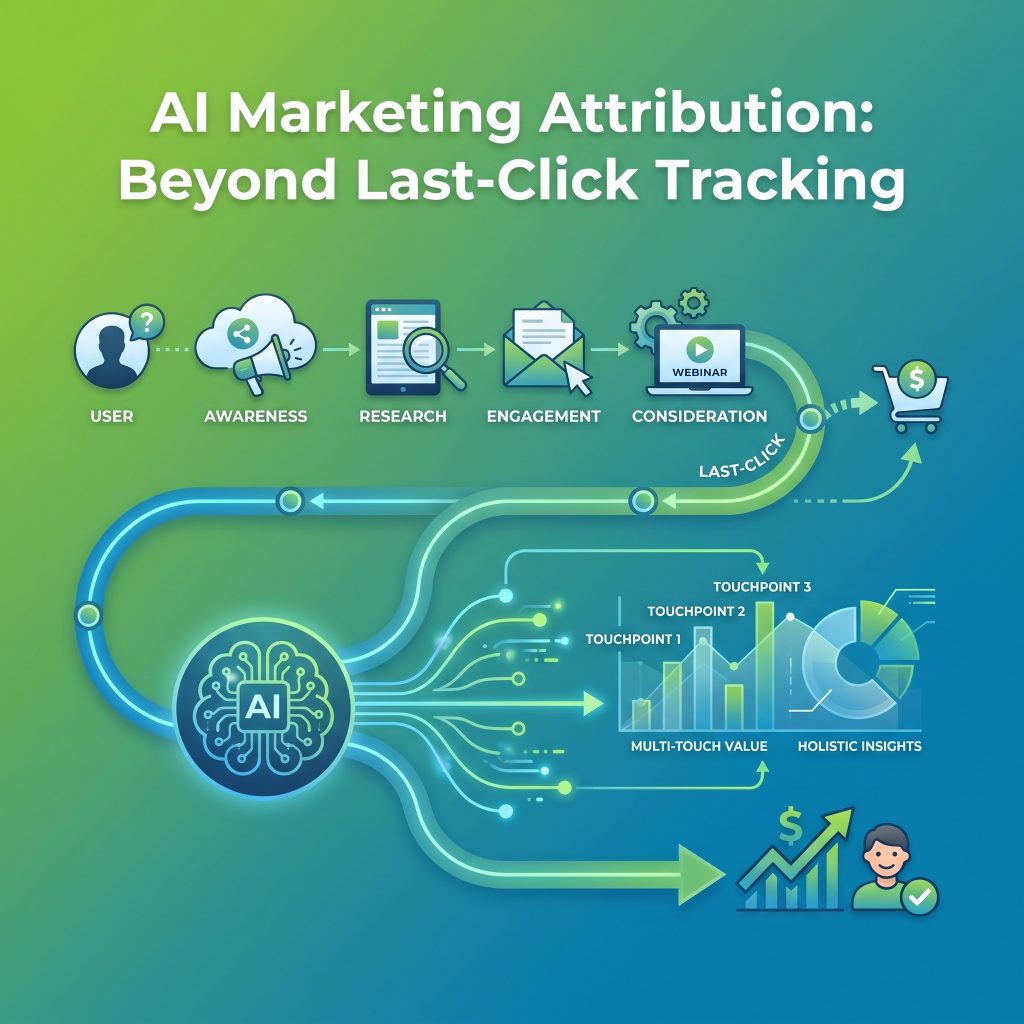
- AI-powered marketing creates attribution complexity because campaigns operate across dozens of touchpoints simultaneously, requiring multi-touch attribution models rather than last-click.
- A credible marketing ROI framework includes four layers: activity metrics, efficiency metrics, pipeline metrics, and revenue metrics, each mapped to a leadership audience.
- Incrementality testing is the most defensible method for proving AI marketing impact to a sceptical CFO, as it isolates the actual uplift driven by a specific campaign or channel.
- Marketing teams that report ROI using a consistent monthly cadence with a one-page executive summary are significantly more likely to retain or increase their AI marketing budget.
Proving marketing ROI to leadership has always been hard. In the AI era, it is harder and more urgent than ever. Budgets for AI-powered marketing are larger, the tooling is more complex, and executives are asking sharper questions. This guide gives you a structured measurement framework to translate AI marketing activity into language that CFOs, CEOs, and boards actually act on.
Why AI Marketing ROI Is Uniquely Difficult to Prove
Traditional marketing measurement was already imperfect. AI-powered marketing adds three new layers of complexity.
First, AI campaigns run across more touchpoints simultaneously. A single customer journey may involve an AI-generated email sequence, a personalised paid social creative, a chatbot conversation, and a retargeting sequence, all optimised by machine learning in real time. Last-click attribution assigns all credit to the final touchpoint and misses everything upstream.
Second, AI optimisation happens in the background. When your campaigns are self-adjusting, it becomes harder to attribute performance to a single decision or investment. Leadership may see results improving without understanding why, which erodes confidence rather than building it.
Third, the value of AI tools is partially operational, speed, scale, and reduced headcount. These benefits do not show up in standard campaign reports unless you build them in deliberately.
The Four-Layer Marketing ROI Framework
A framework that works for leadership separates metrics into four layers. Each layer answers a different question and speaks to a different stakeholder.
Layer 1, Activity Metrics (for marketing teams only)
These are operational inputs: emails sent, ads served, content pieces published, campaigns launched. They prove the team is executing. They should never be the primary metric presented to leadership.
Layer 2, Efficiency Metrics (for marketing directors and operations leads)
Cost per lead (CPL), cost per acquisition (CPA), and content production cost per asset. These metrics demonstrate that AI tooling is reducing waste. As of 2026, businesses using AI-assisted content production report CPL reductions of 25 to 40 percent compared to fully manual workflows, document your own baseline so you can show your specific trajectory.
Layer 3, Pipeline Metrics (for sales leadership and revenue operations)
Marketing-qualified leads (MQLs), sales-qualified leads (SQLs), pipeline value influenced, and deal velocity. These connect marketing activity to sales outcomes. Leadership cares deeply about pipeline because it is a leading indicator of revenue. If your AI campaigns are accelerating lead qualification through automated scoring, that acceleration needs a number attached to it.
Layer 4, Revenue Metrics (for the C-suite and board)
Revenue influenced, customer acquisition cost (CAC), customer lifetime value (CLV), and return on marketing investment (ROMI). This is the layer that secures budget. ROMI is calculated as: (Revenue Attributed to Marketing minus Marketing Investment) divided by Marketing Investment, expressed as a percentage.
Choosing the Right Attribution Model for AI Campaigns
Attribution is where most marketing ROI arguments fall apart. Choosing the right model is not a technical decision, it is a political one, because different models produce very different numbers.
- Last-click attribution credits the final touchpoint before conversion. It is easy to explain but systematically undervalues awareness and nurture campaigns.
- Linear attribution distributes credit equally across all touchpoints. It is fairer but can dilute the perceived impact of high-performing channels.
- Data-driven attribution uses machine learning to weight each touchpoint based on its actual contribution to conversion. This is the most accurate model for AI-powered campaigns, but it requires sufficient data volume and needs clear explanation for non-technical stakeholders.
- Incrementality testing is the gold standard for sceptical leadership. By running matched control and test groups, one exposed to a campaign, one not, you isolate the actual uplift driven by your investment. A 2024 Nielsen study found that incrementality testing revealed paid social was driving 30 percent less incremental revenue than data-driven attribution suggested. The method is rigorous, and CFOs respect it.
Recommendation: use data-driven attribution for ongoing reporting and run incrementality tests quarterly for your highest-spend channels.
Building the Executive ROI Report
The format of your ROI report matters as much as the data inside it. Follow this structure for maximum impact in leadership meetings.
- Lead with the revenue headline. Open with a single number: revenue influenced by marketing in the period. This anchors the conversation.
- Show the efficiency trend. A simple chart showing CAC or CPL over six months demonstrates that AI investment is working. A downward trend is a compelling argument for more budget.
- Connect to pipeline. Include current pipeline value with marketing attribution. This bridges the gap between past results and future revenue.
- Isolate AI-specific contribution. Create a separate row or section that quantifies the impact of AI tools specifically, hours saved, cost reduction, or lift in campaign performance versus the pre-AI baseline.
- End with a forward recommendation. Never end a ROI report without a clear ask. State what additional investment would produce, based on current performance ratios.
Limit this report to one page or one slide. Executives who have to search for the number will lose confidence before they find it.
Setting the Right Reporting Cadence
Consistency builds credibility. A monthly reporting cadence works for most marketing teams, frequent enough to show responsiveness, infrequent enough to show meaningful trends rather than noise.
Quarterly, include a deeper review that compares performance against the targets set at the start of the quarter. Tie these targets back to the business objectives agreed with leadership at the start of the financial year. When your metrics connect to objectives leadership set themselves, the conversation shifts from justification to collaboration.
Common Mistakes That Undermine Marketing ROI Credibility
- Reporting vanity metrics (reach, impressions, follower growth) without connecting them to pipeline or revenue
- Changing attribution models between reporting periods without explaining why
- Presenting AI tool costs in isolation without showing the corresponding output improvement
- Failing to set a pre-AI baseline, making it impossible to demonstrate improvement
- Overcomplicating the report with too many metrics, leadership will focus on the number they understand, so control which number that is
Frequently Asked Questions
What is the best single metric to use when justifying marketing ROI to a CFO?
Customer acquisition cost (CAC) is typically the most persuasive single metric for a CFO because it directly connects marketing spend to revenue generation. Pair it with customer lifetime value (CLV) to show the long-term return on each acquired customer. If CAC is falling while CLV holds steady or rises, you have a compelling case for continued or increased investment.
How do I prove that AI tools specifically are driving the improvement, not other factors?
The most rigorous method is incrementality testing, running matched groups where one receives AI-optimised campaigns and one does not. You can also document a pre-AI baseline and compare performance metrics over time, making the timeline of AI tool adoption explicit. Correlation is not proof, but a consistent improvement trend that begins precisely when AI tools were introduced is a strong argument.
How often should marketing present ROI data to leadership?
A monthly one-page executive summary covers routine reporting. A deeper quarterly review should tie results to the business objectives agreed at the start of the quarter. Ad hoc reporting should be reserved for significant wins or when budget decisions are imminent. Over-reporting creates noise; under-reporting creates doubt.
What should I do if my AI marketing campaigns are not yet generating measurable ROI?
Be transparent about the investment phase. AI campaigns often require two to three months of data before machine learning optimisation produces measurable efficiency gains. Present a clear timeline with leading indicators, improving click-through rates, falling CPL, rising MQL volume, that signal the lagging revenue metrics will follow. Leadership accepts a learning phase when it has a defined end date and clear milestones.
How do I handle attribution disputes between marketing and sales teams?
Establish a shared attribution model that both teams agree on before the measurement period begins, ideally documented in a revenue operations meeting. Data-driven attribution tends to be the most neutral starting point because it is model-based rather than opinion-based. The goal is a single source of truth, not a negotiation at the end of every quarter.