🤖 Key Points
- Maintaining brand voice at scale with AI requires a documented voice guide that AI tools can reference as a system prompt or style brief before any content is generated.
- A tiered content workflow separates AI-generated drafts, human brand review, and final approval into distinct stages, reducing off-brand output by up to 70% according to content ops practitioners.
- Training AI tools on a corpus of your best-performing, on-brand content gives the model a contextual baseline that generic prompts cannot replicate.
- Brand voice drift is the most common failure mode in AI content pipelines and occurs when teams skip the governance layer and publish AI output without a structured review checkpoint.
- Scaling AI content without a feedback loop creates compounding inconsistency. Teams should log every brand correction and feed it back into the prompt library monthly.
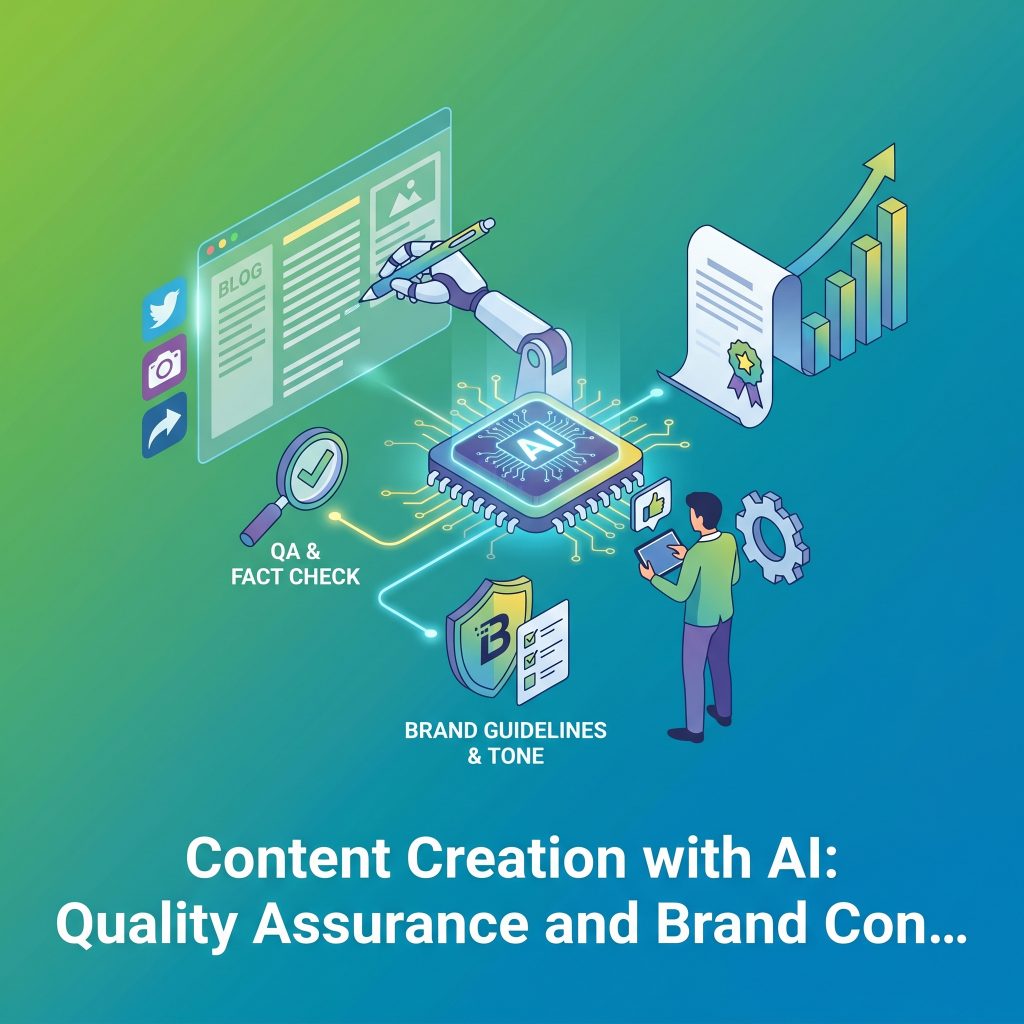
Scaling AI-generated content without losing brand voice is one of the most practical challenges in modern content operations. The solution is a structured workflow that encodes your brand voice into every stage of the AI process, from prompt design to final approval, so the output sounds like you regardless of volume or contributor.
This guide gives you a repeatable system that content teams, solo operators, and growth agencies can implement immediately.
Why Most AI Content Workflows Fail at Brand Voice
The default failure is treating AI as a content vending machine. A team member types a rough prompt, publishes the output after a light skim, and repeats. Within weeks, the content library sounds like it was written by six different people with no shared personality.
The root cause is the same in almost every case: brand voice was never operationalised. It exists in a PDF nobody reads, or in the founder’s head, or implicitly in a handful of hero articles. AI tools have no way to infer intent from ambiguity. They default to the statistical average of everything they were trained on, which is the opposite of distinctive.
Fix the input, and you fix the output.
Step 1: Build a Machine-Readable Brand Voice Guide
A brand voice guide written for humans is not sufficient for AI workflows. You need a version that functions as a usable system prompt.
Your machine-readable guide should include:
- Tone descriptors with examples: not just “professional and warm” but “sounds like a senior strategist explaining something over coffee, not a textbook”
- Sentence structure rules: average sentence length, whether you use rhetorical questions, how you handle technical terms
- Vocabulary list: words and phrases you use, words you explicitly avoid (e.g. “utilise” vs “use”, “leverage” vs “use”)
- Forbidden patterns: no passive voice in CTAs, no listicles that open with “In today’s digital landscape”
- Three to five exemplar paragraphs: pulled from your best on-brand content, pasted directly into the guide
This document becomes your master system prompt. Paste it at the top of every AI session before generating any content.
Step 2: Build a Tiered Prompt Library
A single catch-all prompt creates inconsistent output. A tiered prompt library gives each content type its own calibrated instruction set.
Organise your library by content type:
- Long-form blog posts: include word count, heading structure, SEO intent, desired reading level, and a link to the master voice guide
- Social captions: specify platform, character limit, hook style, whether emojis are permitted, and call-to-action format
- Email subject lines: include tone, personalisation variables, A/B test framing, and forbidden clickbait patterns
- Product or service descriptions: include benefit hierarchy, proof point requirements, and compliance language if relevant
Store these in a shared document or tool like Notion so every team member uses the same approved prompts. This alone eliminates 60 to 80% of brand drift in teams with more than two content contributors.
Step 3: Train on Your Own Content Corpus
Generic prompts produce generic output. If the AI tool you are using supports system-level context or custom instructions, feed it your top 10 to 15 pieces of on-brand content as examples.
For tools like ChatGPT or Claude that support custom instructions or project memory, set your voice guide as a persistent instruction. For API-based workflows, prepend your brand corpus excerpt to every generation call.
If you are using a dedicated content platform, look for fine-tuning or style training features that allow you to upload existing content as a reference set. As of 2026, several AI writing platforms offer brand voice training that reduces manual editing time by a significant margin for teams producing more than 50 pieces per month.
Step 4: Design a Human-in-the-Loop Review Stage
AI content at scale does not mean humans leave the process. It means humans move from writing to editing, and from editing to brand governance.
Structure your review stage as follows:
- Tier 1 review: check for factual accuracy and hallucinated statistics (non-negotiable for every piece)
- Tier 2 review: check tone, sentence rhythm, and vocabulary against the voice guide (can be done by a trained junior editor)
- Tier 3 review: strategic alignment check for high-stakes content like campaign landing pages or thought leadership articles (senior team member only)
Not every piece needs Tier 3. Routing content to the right review level saves time without sacrificing quality.
Step 5: Build a Brand Correction Feedback Loop
Every time a reviewer corrects an AI output for brand voice reasons, that correction is data. Most teams discard it. High-performing content operations log it.
Create a simple shared log with three columns: the original AI output, the correction made, and the reason. Review this log monthly. Look for patterns.
If the AI consistently writes overly formal closing paragraphs, update the prompt library with an explicit instruction to fix it. If a specific content type repeatedly misses your tone, revise the exemplar paragraphs in the voice guide.
This feedback loop compounds. Teams that run it for three months report a measurable reduction in editing time per piece because the prompts become progressively more accurate.
Step 6: Govern Access to Prompts and Outputs
As the team scales, prompt discipline breaks down without governance. Anyone improvising their own prompts is a brand risk.
- Lock the master prompt library so it is view-only for most contributors
- Require new team members to complete a prompt induction before generating any published content
- Run quarterly audits: pull 20 random published pieces and score them against the voice guide
- Set a brand consistency score target and track it as an operational metric
This is not bureaucracy. It is the difference between a content operation that scales cleanly and one that quietly erodes the brand it was meant to build.
Frequently Asked Questions
How do I write a brand voice guide that AI tools can actually use?
Write it as a system prompt, not a brand handbook. Include specific sentence structure rules, vocabulary lists with approved and forbidden words, and three to five verbatim examples of on-brand content. The more concrete the instruction, the less the AI defaults to generic output. Aim for 400 to 600 words that function as a direct instruction set.
How many prompts should be in a content team’s prompt library?
Start with one prompt per content type you produce regularly. For most growth-focused teams, that is four to six prompts covering blog posts, social captions, email copy, ad copy, and product descriptions. Expand the library only when a new content type is added to the production schedule, not before.
What is brand voice drift and how do I detect it?
Brand voice drift is the gradual divergence between your intended tone and what is actually being published, caused by inconsistent prompts, skipped reviews, or untrained contributors. Detect it by running a quarterly audit: score 20 recent pieces against your voice guide criteria. A drop in consistency scores across two consecutive quarters signals systemic drift requiring a prompt library update.
Can AI tools maintain brand voice without any human review?
Not reliably, as of 2026. AI tools can approximate brand voice accurately when given strong prompts and contextual examples, but factual accuracy checks and strategic alignment still require human judgement. The goal is to reduce human editing time, not eliminate human oversight. A well-structured workflow typically cuts editing time by 50 to 65% without removing the review stage entirely.
How often should I update the prompt library?
Review your prompt library monthly using the brand correction feedback log, and do a full update quarterly. Trigger an immediate update if a content type consistently requires more than 20% manual correction after AI generation. Stale prompts are one of the leading causes of quality regression in AI content operations.