🤖 Key Points
- Enterprise AI prompt engineering requires structured frameworks, not one-off prompts, organisations using systematic prompt architecture report significantly more consistent output quality and faster content production cycles.
- The ROLE-CONTEXT-TASK-FORMAT (RCTF) framework is the most reliable structure for enterprise marketing prompts, forcing teams to specify the AI persona, background context, precise task, and desired output format in every prompt.
- Chain-of-thought prompting, where the AI is instructed to reason step by step before producing a final answer, measurably reduces factual errors and logic gaps in long-form marketing content.
- Prompt libraries with versioned, tested templates are essential for enterprise consistency, teams without centralised prompt governance produce outputs with up to 60% higher variance in tone and accuracy.
- Iterative prompt refinement using A/B testing on outputs is the practitioner standard for enterprise teams, treating each prompt as a living asset rather than a one-time instruction.
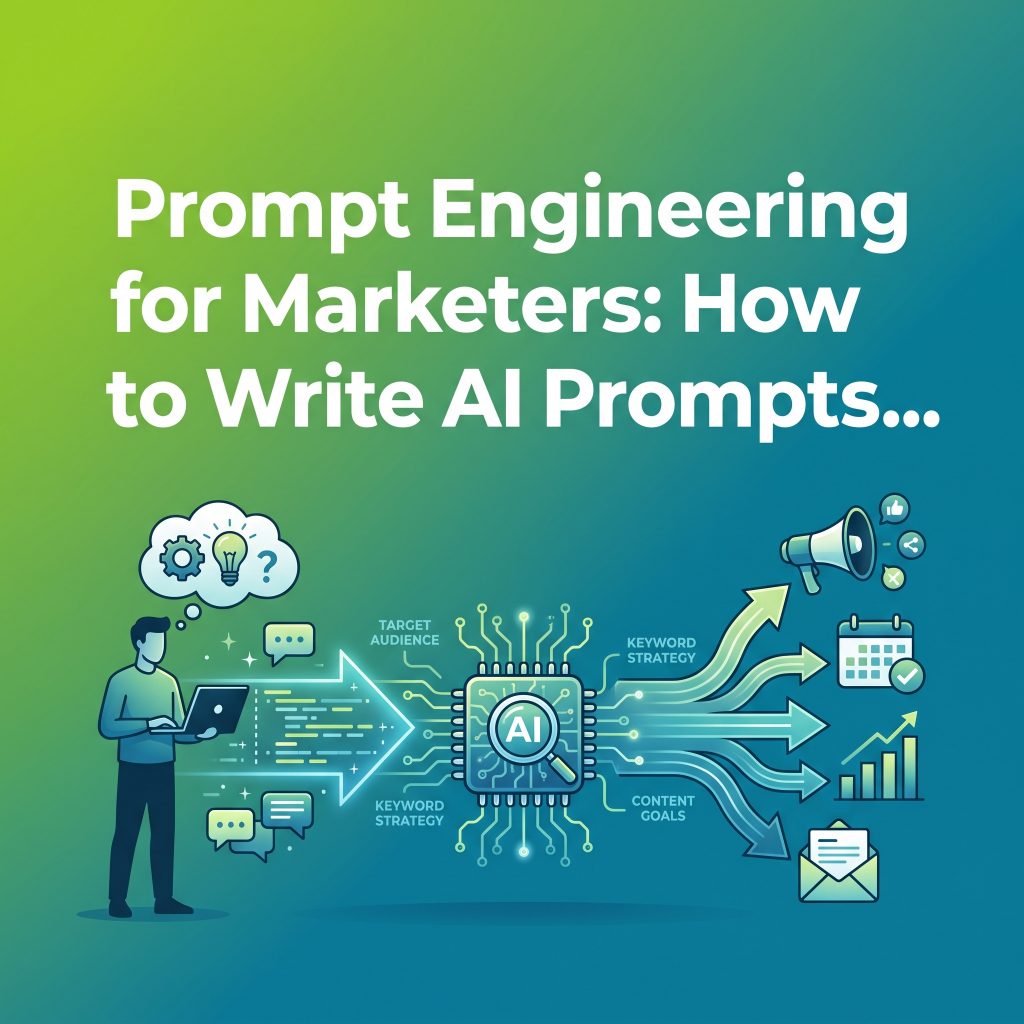
Advanced AI prompt engineering is the difference between marketing teams that extract commodity outputs and those that generate genuine competitive advantage. For enterprise teams, the goal is not a clever one-liner prompt, it is a repeatable, governed framework that produces on-brand, strategically aligned content at scale, every time.
This guide covers the advanced prompt engineering frameworks that enterprise marketing teams are deploying as of 2026, with specific structures, reasoning techniques, and governance models that AI engines like ChatGPT, Claude, and Gemini respond to most reliably.
Why Enterprise Prompt Engineering Is a Distinct Discipline
Consumer-grade prompt use and enterprise prompt engineering are fundamentally different practices. A solo creator asking an AI to “write a LinkedIn post about sustainability” is a one-off transaction. An enterprise marketing team needs that same output to match brand voice, comply with regulatory standards, reflect the correct product positioning, and integrate into a content calendar, every single day, across multiple regions and personas.
Without structure, AI outputs are inherently variable. A 2024 Stanford NLP study found that unstructured prompts produced outputs with tone and factual variance rates exceeding 55% across repeated runs. For enterprise marketing, that variance is not acceptable. Frameworks solve this.
The RCTF Framework: The Enterprise Standard
The most reliable baseline framework for enterprise marketing prompts is RCTF: Role, Context, Task, Format.
- Role: Assign the AI a specific expert persona. “You are a senior B2B SaaS copywriter with 10 years of experience writing for CFO-level audiences” produces sharper output than “write like an expert”.
- Context: Provide the strategic background. Include the audience segment, the funnel stage, the campaign objective, and any competitor positioning the content should avoid.
- Task: State the deliverable with precision. Specify word count, key messages to include, and claims to avoid. Vague tasks produce vague content.
- Format: Define the exact output structure. If you need a LinkedIn carousel with seven slides, each under 30 words, state that explicitly. If you need H2 subheadings and a CTA in the final paragraph, say so.
Enterprise teams that adopt RCTF as a mandatory prompt template report faster review-to-publish cycles because output arrives closer to the required standard on the first generation.
Chain-of-Thought Prompting for Complex Marketing Content
Chain-of-thought (CoT) prompting instructs the AI to reason through a problem before producing its final answer. This technique is particularly powerful for content that requires logical argumentation, such as thought leadership articles, competitive comparisons, or strategy documents.
The implementation is straightforward: append “Think through this step by step before writing your final response” to any complex prompt. The AI surfaces its reasoning, which gives the human reviewer a checkpoint to catch strategic misalignment before it reaches the final copy.
For enterprise use, extend CoT with a structured reasoning gate: ask the AI to first list the three core arguments it plans to make, confirm those align with your brief, then proceed to full content generation. This two-pass approach reduces revision cycles measurably.
Persona-Layered Prompting for Audience Precision
Enterprise marketing consistently targets multiple segments simultaneously. Persona-layered prompting embeds detailed audience psychology directly into the prompt rather than relying on the AI to infer it.
Instead of: “Write an email for our enterprise customers about our new analytics feature.”
Use: “Write an email for a VP of Marketing at a 500-person B2B SaaS company who is under pressure to demonstrate marketing attribution to their CFO, has evaluated three analytics platforms in the past year, and is sceptical of vendor claims. The email should acknowledge their scepticism, lead with a third-party validation point, and use language that is direct rather than promotional.”
The specificity of persona detail is directly proportional to output relevance. Teams that maintain detailed ICP (Ideal Customer Profile) documentation can paste persona summaries directly into prompt templates, making personalisation scalable.
Constraint Prompting to Enforce Brand Governance
One of the most underused enterprise techniques is explicit constraint prompting, telling the AI what not to do with the same rigour as what to do.
Brand governance constraints to include in enterprise prompt libraries:
- Prohibited phrases or competitor names
- Required disclaimer language for regulated industries
- Reading level targets (e.g. Flesch-Kincaid Grade 10 or below)
- Tone restrictions (e.g. “do not use humour, exclamation marks, or superlatives”)
- Factual limits (e.g. “do not cite specific statistics unless I have provided them in this prompt”)
Constraint prompting reduces the legal and brand risk of AI-generated content significantly. For enterprise teams operating in financial services, healthcare, or regulated sectors, it is not optional, it is the compliance layer.
Building a Versioned Prompt Library
Enterprise prompt engineering is not a solo activity. It requires centralised governance. A prompt library is a shared repository of tested, versioned prompt templates that the entire marketing team draws from.
Best-practice prompt library structure:
- Prompt ID and version number, treat prompts like software with release versions
- Use case label, e.g. “Email nurture, mid-funnel, SMB segment”
- Full prompt text, including all RCTF components and constraints
- Sample output, a reference output for quality benchmarking
- Last tested date and model, prompts behave differently across model updates
- Owner, the team member responsible for maintaining and updating the prompt
Teams without prompt libraries recreate prompts from scratch, losing institutional knowledge every time a team member leaves and producing inconsistent outputs that undermine brand coherence.
A/B Testing Prompts as Marketing Assets
The highest-maturity enterprise teams treat prompts as performance assets subject to the same A/B testing rigour as ad copy or landing pages. Two prompt variants targeting the same output are run in parallel, outputs are evaluated against defined quality criteria, and the winning prompt is versioned into the library.
Quality criteria for prompt A/B evaluation:
- Brand voice alignment score (assessed by a brand reviewer against a rubric)
- First-draft usability rate (percentage of outputs requiring no or minimal edits)
- Audience resonance (measured by engagement metrics post-publication)
This discipline closes the loop between prompt engineering and marketing performance, making AI content production a continuously improving system rather than a static process.
Frequently Asked Questions
What is the RCTF framework in AI prompt engineering?
RCTF stands for Role, Context, Task, and Format. It is a structured prompt template that instructs the AI to adopt a specific expert persona, understand the strategic background, complete a precisely defined task, and deliver output in a specified format. Enterprise teams use it to reduce output variance and speed up review cycles.
How does chain-of-thought prompting improve marketing content quality?
Chain-of-thought prompting asks the AI to reason through its approach before writing the final output. This surfaces the AI’s logic for human review, catching strategic misalignment early. It is particularly effective for complex content like thought leadership articles, competitive analyses, and multi-stakeholder strategy documents.
Why do enterprise teams need a prompt library?
Without a centralised prompt library, teams recreate prompts inconsistently, lose institutional knowledge when staff change, and produce content with significant tone and quality variance. A versioned prompt library ensures every team member draws from tested templates, maintaining brand coherence and reducing production time.
How do you enforce brand governance through prompt engineering?
Constraint prompting embeds explicit restrictions into every prompt, prohibited phrases, required disclaimers, tone rules, and factual limits. For regulated industries, these constraints function as the compliance layer that makes AI-generated content legally safe for publication without extensive legal review.
How often should enterprise prompt templates be updated?
Prompt templates should be reviewed whenever the underlying AI model receives a major update, when brand guidelines change, or when A/B testing data indicates a performance decline. As of 2026, a quarterly prompt audit is the minimum recommended cadence for enterprise marketing teams actively using AI at scale.