
Executive Summary:
For the last two decades, internet growth was measured by human eyeballs and clicks. How many smartphones were in pockets? How many hours were spent scrolling? Today, that era is over. The bottleneck is no longer human attention; it is compute and energy.
In 2026, Generative AI has transitioned from a novel creative tool into the foundational infrastructure of the global economy. We have moved from “assistants” that draft emails to autonomous “agents” that execute complex, multi-step workflows. Welcome to the era of synthetic execution.
| The 2019 Metric | The 2026 Metric |
|---|---|
| Smartphone Penetration | Edge AI & On-Device Processing |
| Time Spent on Screens | Time Saved via Automation |
| E-Commerce Conversion | Hyper-Personalized Synthetic Commerce |
| Freemium Subscriptions | API Calls & Compute-as-a-Service |
| Cloud Computing Growth | The Energy & Infrastructure Bottleneck |
01. The Shift to Agentic AI
The defining shift of 2026 is the transition from AI as a conversational assistant to AI as an autonomous agent. We are no longer just prompting; we are delegating. The gap between initial experimentation and production-scale deployment is rapidly closing as organizations integrate agents directly into their core operations.
The Adoption Reality
- 88% of organizations now report using AI in at least one business function [1].
- 79% of enterprises report that AI agents are already being adopted within their organizations [1, 2].
- 97% of executives say their company deployed AI agents in the past year, with 52% of employees already using them [3].
- Gartner predicts that 40% of enterprise applications will include task-specific AI agents by the end of 2026 [2].
- 15% of day-to-day business decisions could soon be made autonomously by AI agents [1].

The Enterprise ROI
- While 66% of organizations using AI agents have seen measurable productivity gains, significant financial ROI remains elusive for most [1].
- Only 29% of organizations report seeing significant ROI from generative AI, and just 23% report significant ROI from AI agents [3].
- However, targeted deployments are showing massive success: Salesforce’s Agentforce handled over 380,000 customer support interactions and resolved 84% of cases autonomously, requiring human escalation for only 2% [2].
- AtlantiCare deployed an agentic AI clinical assistant that cut documentation time by 42%, freeing roughly 66 minutes per clinician per day [2].
- The highest performers are those pursuing broader outcomes like growth and innovation, placing a central focus on workflow redesign rather than just basic tool deployment [4].
The Execution Gap
- A massive execution gap exists: while 79% of enterprises have adopted AI agents, only 11% are actively running them in production [2].
- 79% of organizations face challenges in adopting AI, with nearly half (48%) calling their AI adoption efforts a massive disappointment [3].
- The gap between individual productivity wins and organizational outcomes reveals that structural transformation, rather than mere software deployment, is what is missing [3].
The 2026 Takeaway: Organizations reporting genuine, structural ROI are those that have successfully redesigned their transaction boundaries, explicitly identifying which steps can be fully and autonomously executed by the system without human intervention.
02. Multimodal Ubiquity
The barriers between text, audio, and video have completely dissolved. In 2026, AI is no longer constrained to a text box; it sees, hears, and speaks in real-time. Single-modality models are now considered niche [5].
The Multimodal Market Ramp-Up
- The global Multimodal AI market is estimated to reach $3.23 billion in 2026 [6].
- Analysts forecast that 40% of all generative AI solutions will be multimodal by 2027 [7].
- Currently, image data dominates this space, accounting for a 41.3% share of the multimodal market due to its high importance across multiple domains [6].
- Screenless, audio-based conversational experiences are increasingly becoming a primary entry point for information consumption [8].
- The traditional lines between reading, listening, and interacting are fundamentally blurring [8].
The Video Compression
- 91% of businesses now use video as a marketing tool in 2026 [9].
- 63% of these video marketers use AI tools to help create or edit their content [9].
- The average time to produce a 60-second marketing video has dropped from 13 days down to just 27 minutes [9].
- Consequently, AI video tools are saving the average marketing team roughly 34 hours per week that were previously spent on production and editing [9].
How We Generate Media Now
- Text-to-video is the dominant creation method, accounting for 46.3% of the AI video generation market [9].
- Interestingly, PowerPoint-to-video has emerged as the fastest-growing niche segment in the AI video space [9].
- Vertical format (9:16) now dominates the output, representing 59% of all AI-generated videos in 2026, up significantly from 31% in 2024 [9].

03. The Compute Economy
Compute is the new oil. As AI models scale from experimental software to enterprise-grade infrastructure, the digital economy has collided hard with the physical world. The defining narrative of 2026 is the race to secure enough power grids, cooling systems, and specialized silicon to keep the models running.
The Infrastructure Mega-Build
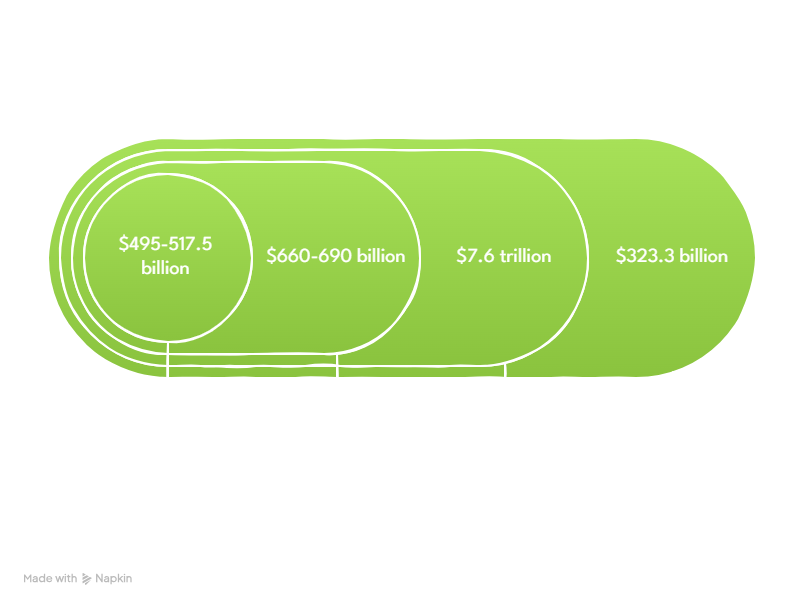
- The global artificial intelligence systems spending market is expected to reach $323.3 billion in 2026 [10].
- Aggregate AI capital expenditure (CapEx) across compute, data centers, and power is projected to hit roughly $7.6 trillion between 2026 and 2031 [11].
- Combined hyperscaler CapEx is reaching between $660 and $690 billion in 2026 alone [12].
- Approximately 75% of those hyperscaler dollars are being directed specifically at building out AI infrastructure [12].
The Data Center Energy Crisis
- The energy consumption of data centers is expected to approach 1,050 TWh by 2026 [13].
- If data centers were a country, this 1,050 TWh consumption would make them the fifth-largest energy consumer in the world, ranking between Japan and Russia [13].
- In 2026, five distinct US data centers are set to become the first globally to use more than 1GW of electricity at their peak—which is the equivalent of a nuclear reactor’s total output [14].
- To manage the extreme heat generated by these massive workloads, liquid cooling systems within data centers are expanding at a rapid 24.5% CAGR [15].
Silicon Diversification: The Rise of Custom ASICs
- While Nvidia remains dominant, its revenue market share is projected to shift from an 87% peak in 2024 down to approximately 75% in 2026 as the total addressable market rapidly expands past $200 billion [16].
- The landscape is dramatically shifting toward custom silicon (ASICs) developed directly by cloud providers, such as Google’s TPU v7, Amazon’s Trainium 3, and Microsoft’s Maia 200 [12].
- These custom ASICs are growing at a staggering 44.6% CAGR, specifically targeting the AI inference workloads that now represent two-thirds of all AI compute [12].
- Industry benchmarks indicate that these custom accelerators can reduce inference costs by 40% to 60% compared to traditional GPU deployments [17].
- Because they are purpose-built for AI, these custom chips also consume 30% to 50% less power per inference operation, providing crucial relief to the data center energy crisis [17].
04. The New ROI of Enterprise AI
The experimental phase of enterprise AI has ended. In 2026, the corporate focus has shifted aggressively from measuring “hours saved” to executing total organizational redesigns. The return on investment (ROI) is no longer just about software adoption—it is about fundamentally restructuring the human workforce around AI systems.
The Productivity Reality Check
- The global AI Copilot software and services market has surged, reaching an estimated $12 billion to $18 billion in 2026 [18].
- Workforce productivity improvement is the undisputed primary business justification, cited by 78% of enterprise buyers as their main expected ROI driver [18].
- In specialized fields like software engineering, the gains are staggering: AI copilots are delivering productivity improvements of up to 73% on routine coding and documentation tasks [19].
- However, in broader operational deployments (like Microsoft 365 Copilot), organizations note that while the tools are beneficial for summarization and retrieval, their impact is still constrained by the absolute necessity of human oversight to validate AI-generated outputs [20].
The Great Workforce Restructuring
- A staggering 98% of executives are currently planning major organizational design changes centered around AI [21].
- According to Mercer’s Global Talent Trends 2026 report, 99% of C-suite leaders expect AI to lead to at least some headcount reduction over the next two years [21].
- But the reality is more about redeployment than outright mass layoffs: 65% of executives expect between 11% and 30% of their workforce to be redeployed or reskilled [21].
- Big Tech is executing this blueprint publicly. In 2026, Meta cut 8,000 jobs (roughly 10% of its workforce) while simultaneously freezing 6,000 open roles and reassigning 7,000 existing employees into AI-aligned functions [22, 23].
The Human Morale Toll
- Only 44% of employees report that they are “thriving” at work in 2026, representing a massive 22-point morale drop from 66% in 2024 [21].
- Over the same two-year stretch, active employee worry about losing their jobs to AI has climbed from 28% to 40% [21].
- 62% of employees believe corporate leaders are vastly underestimating AI’s emotional impact on the workforce, yet only 19% of HR leaders have folded that emotional impact into their digital rollout plans [21].
05. Open vs. Closed Ecosystems
The ideological and commercial battle for the foundation of AI has reached a new equilibrium in 2026. Rather than a winner-take-all scenario, the market has fractured into a highly strategic hybrid approach. Open-source models have aggressively closed the performance gap, empowering enterprises to take back control of their data, while proprietary giants maintain their edge in frontier cognitive tasks.
The Cost and Performance Convergence
- While closed, proprietary models still account for roughly 80% of total AI model usage, the financial dynamics are shifting rapidly [24].
- Proprietary models cost users an average of six times more than open-source alternatives; running inference on an open model is 87% cheaper [24].
- Open models now achieve approximately 90% of the performance of closed models upon release, and community-driven fine-tuning quickly erases the remaining gap [24, 26].
- Analysts project that optimally reallocating demand from closed to open models could save the global AI economy $25 billion annually [24].
- As a result, 89% of organizations using AI are now integrating open-source components into their infrastructure, and 63% are working directly with open models [25].
The Hybrid Enterprise Standard
- The dominant architectural standard for businesses in 2026 is a hybrid deployment [26].
- Organizations are utilizing highly efficient open-source models for the bulk of their workloads—handling up to 80% of their volume for routine queries and customer service [26].
- Expensive proprietary models are now selectively reserved only for tasks requiring the absolute highest levels of complex reasoning, creativity, and analysis [26].
- Avoiding vendor lock-in has surged as a primary driver, cited by 55% of open-source adopters in 2026—a massive 68% year-over-year increase [27].
- This shift is heavily geopolitical: 63% of organizations in the EU and UK identify vendor lock-in as a top concern, utilizing open-source models to ensure digital sovereignty and strict GDPR compliance without relying on US-based servers [26, 27].
The Edge AI Revolution
- 2026 marks the definitive industry shift from massive, generalized Large Language Models (LLMs) to highly efficient, task-specific Small Language Models (SLMs) [28].
- These “Micro LLMs” require significantly less power and compute, shifting intelligence out to the “edge” (smartphones, laptops, and local sensors) [28].
- Driven by the demand for real-time, low-latency processing and enhanced data privacy, the edge AI software market is accelerating at a massive 34.8% compound annual growth rate [29].
- Embedded, resource-constrained AI systems are now fully capable of running complex agentic workflows and on-device generative AI entirely offline [29].

06. The Global Regulatory Race
AI development has officially fractured along geopolitical lines, creating distinct technological ecosystems. In 2026, the landscape is defined by a fierce capital race between the US and China, the strict regulatory enforcement of the European Union, and the urgent deployment of “digital provenance” tracking to save the internet from a flood of synthetic media.
The Geopolitical Investment Divide
- Global AI investment has surged to a staggering $581.7 billion [32].
- The US dominates private capital, with private AI investment reaching $285.9 billion—roughly 23 times the private investment seen in China [32].
- However, this private data obscures the true global standing: the Chinese government has injected an estimated $184 billion through state-owned funds, aggressively closing the total funding gap [32].
- The resulting dynamic is highly specialized: the US heavily leads in total computing power, capital, and frontier foundation models, while China dominates global AI patents, research papers, and industrial robot deployment [32].
Regulatory Divergence: The EU AI Act Takes Effect
- The European Union’s landmark AI Act has entered its critical enforcement phases throughout 2025 and 2026 [31].
- A major regulatory milestone hits in August 2026 with the enforcement of Article 50, which strictly requires providers to include machine-readable disclosures (such as watermarking) on all AI-generated content [30, 36].
- The powers granted to the EU AI Office are unprecedented, including the ability to demand documentation from developers, commission independent evaluations of models, and access source code [31].
- The financial stakes for enterprise noncompliance are massive, with the EU authorized to impose fines of up to 3% of a company’s global annual turnover [31].
Digital Provenance: The New Trust Currency
- Europol projections warn that up to 90% of all online content could be synthetically generated by 2026 [36].
- Consequently, Gartner has officially named “digital provenance”—the verifiable record tracing a digital asset from its creation—as one of its Top 10 Strategic Technology Trends for 2026 [34, 36].
- The Coalition for Content Provenance and Authenticity (C2PA) has rapidly become the undisputed global standard, expanding to over 6,000 members and affiliates by January 2026, including tech giants like Google, Meta, OpenAI, Sony, and Nikon [33].
- Digital provenance is no longer just a software patch; it is being baked directly into hardware, with flagship devices like Samsung’s Galaxy S25 and Google’s Pixel 10 now cryptographically signing content natively through C2PA at the exact moment of capture [35].